Brand and retail rollouts
Use the machine as a branded pickup endpoint inside a wider ecommerce or omnichannel journey.
VendingTracker lets brands, retailers, and operators accept orders online and complete pickup at the vending machine with reservation and pickup-code control.
That turns the machine into a secure self-service pickup point for ecommerce, Shopify, and click-and-collect rollouts rather than only a walk-up sales endpoint.
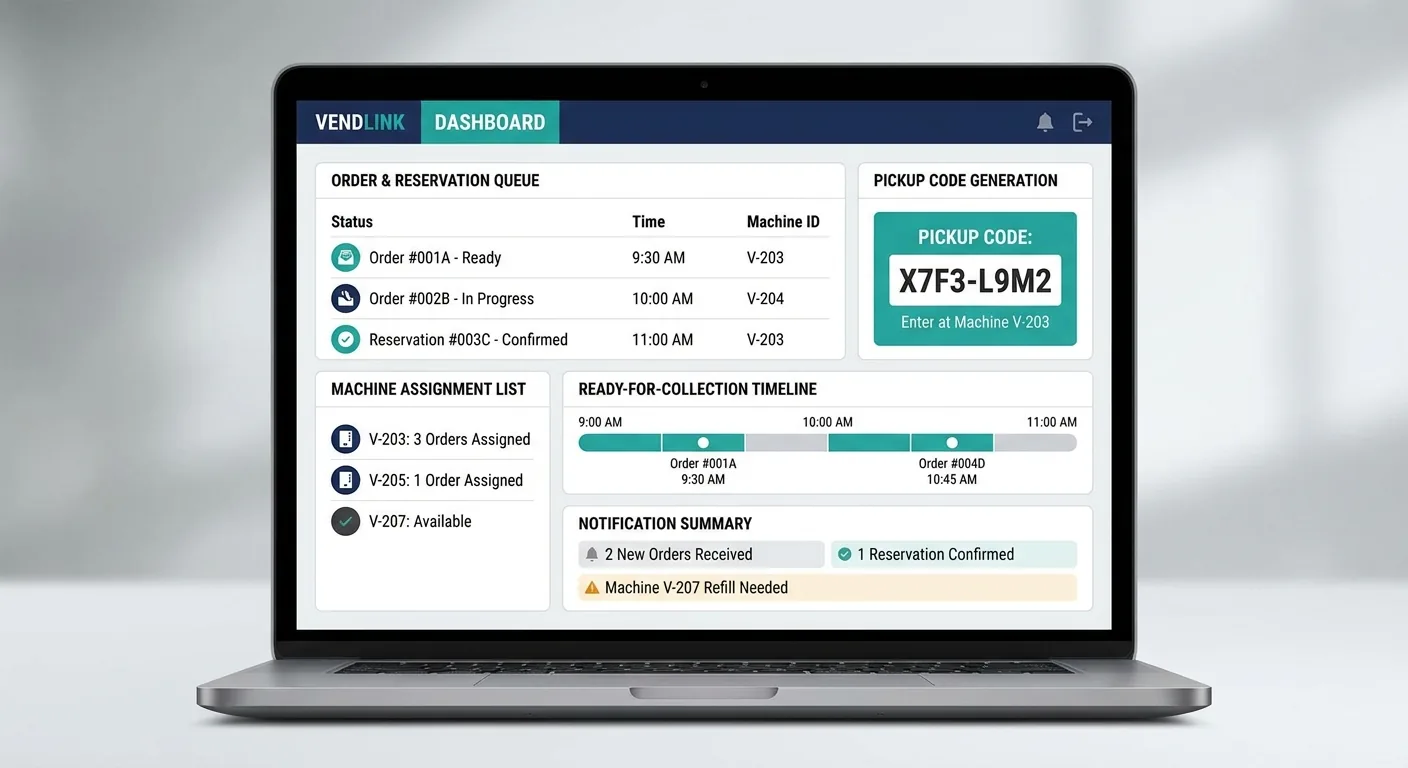
Retail and ecommerce teams usually search for click and collect, online order pickup, buy online pick up in store, or buy online pick up in locker. The commercial problem is the same each time: complete checkout online, hold the order safely, and hand it over through a convenient local pickup point.
VendingTracker applies that same pattern to a vending endpoint. The shopper buys online, the order is reserved against a specific machine, and pickup happens through a controlled self-service flow rather than a staffed counter.
The customer places an order online, selects or is assigned a pickup machine, and completes checkout through the ecommerce flow. VendingTracker then reserves the inventory against that machine and holds the order until pickup or expiry.
When the order is ready, the customer receives a unique pickup code or equivalent confirmation. At the machine, that code unlocks the pickup workflow so the order can be collected cleanly without a staffed handoff.
For smaller businesses, the practical version of this story is often Shopify or another ecommerce platform feeding a pickup workflow at the machine. For bigger brands, it may be a custom website, app, or omnichannel checkout path with the vending machine acting as the final pickup point.
VendingTracker does not pretend every ecommerce stack behaves the same. Shopify, custom checkout, and broader commerce integrations should be scoped around the real order source, stock logic, pickup experience, and machine environment before implementation is promised.
Big brands like the model because it extends ecommerce convenience into physical pickup without relying on staffed counters everywhere. Smaller businesses like it because the machine can behave like a local pickup point without needing a traditional storefront handoff process.
The result is a workflow that feels familiar to click-and-collect buyers while giving the operator tighter control over pickup timing, order state, and the physical endpoint.
Use the machine as a branded pickup endpoint inside a wider ecommerce or omnichannel journey.
Turn an online store into a local self-service pickup model without adding a staffed pickup desk.
Keep order status, reservation timing, and pickup completion visible instead of hoping a manual handoff holds together.
Use the links below to move from keyword research into the right workflow or integration conversation.
Click and collect vending is a workflow where the customer orders online and picks up the order at a vending machine rather than only at a staffed counter or locker bank.
It is closely related. Buyers may describe the model as click and collect, buy online pick up in store, or buy online pick up in locker. VendingTracker applies the same self-service pickup logic to a vending-machine endpoint.
Shopify-connected pickup workflows can be reviewed in scoped integration projects where the checkout, inventory, reservation, and machine pickup flow make commercial and technical sense.
That depends on the deployment design. Machine selection, location logic, and reservation rules can be scoped around how the rollout needs to work.
The order can be reserved against a machine, tracked through defined statuses, and released to the customer at pickup using a code or equivalent claim method before the reservation expires.
Book a demo, request a compatibility review, or start an integration conversation with the right technical context from the start.